
Mirndiyan Gununa: an embedded case study of workplace dynamics of a remote Indigenous Art Centre
Researcher
Dr Linda Carroli & JM John Armstrong
Published
7 April 2026
Funding
Design Strategy Research
There are well over 100 Indigenous Art Centres (IACs) in Australia, operating primarily in remote communities across the Australian mainland and islands including the Torres Strait.
Australia’s remote places are geographically dispersed and diverse, with IACs located in some of Australia’s remotest areas. IACs are a critical platform in the development and maintenance of Indigenous cultural and arts practice and markets. As infrastructures, they also contribute to economic development, livelihoods and employment in remote areas and on Country.
n 2024, the Alastair Swayn Foundation provided a Design Strategy Grant to Dr Linda Carroli (Visiting Fellow, QUT Design Lab) for a project investigating IACs as workplaces. The objectives of this project were:
Investigate the experience of Indigenous Art Centres as workplaces (via literature review and embedded case study)
Investigate the design implications of Indigenous Art Centres as workplaces (via embedded case study)
Indigenous Art Centres are not widely researched, particularly from a work or workplace perspective. This project is an initial step involving preliminary field orientation and data collection for ongoing research that examines Indigenous Art Centres as workplaces through design and facility management challenges and opportunities. The intention is to inform capacity building to develop strategies for capital works and facility management.
Findings and Outputs
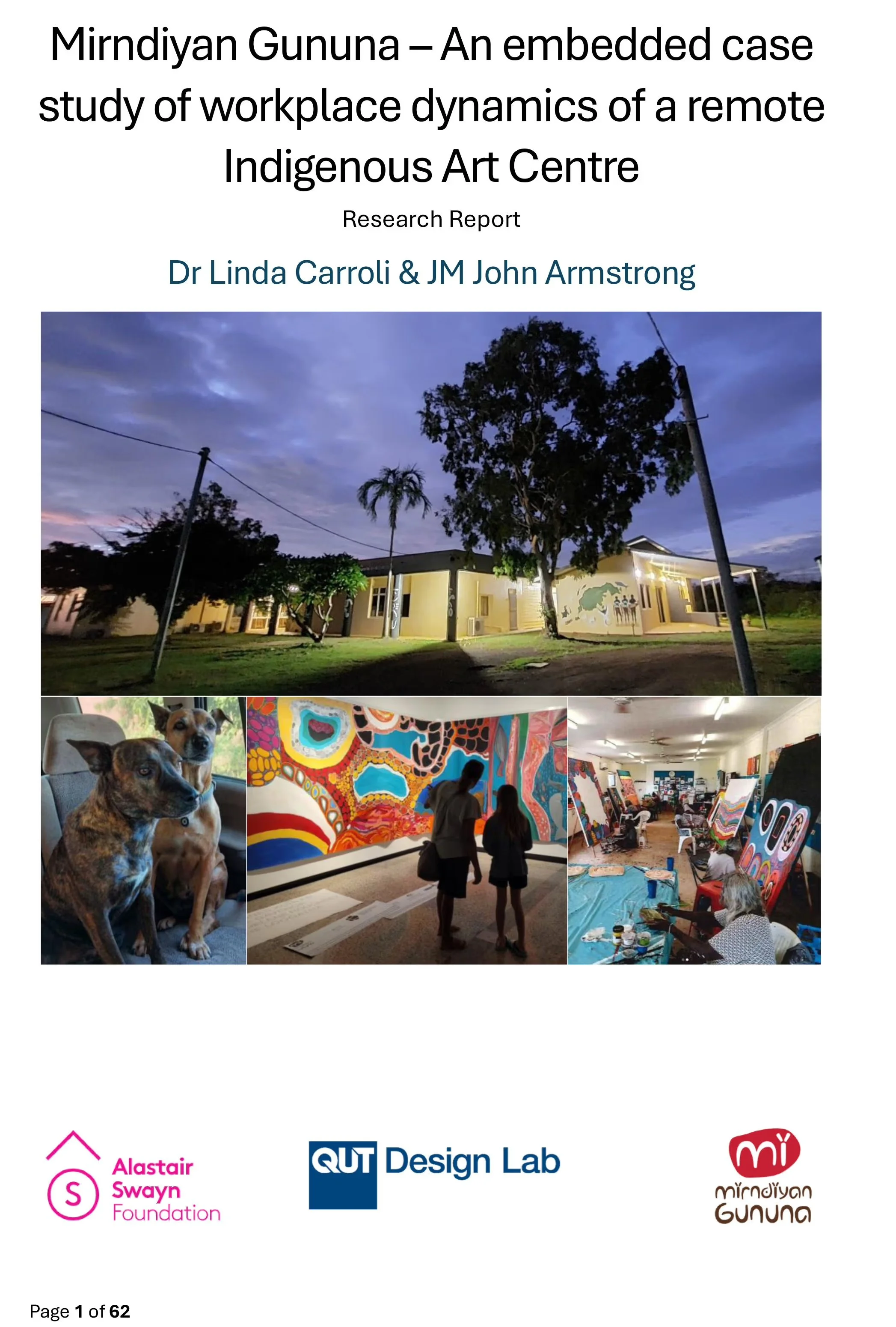
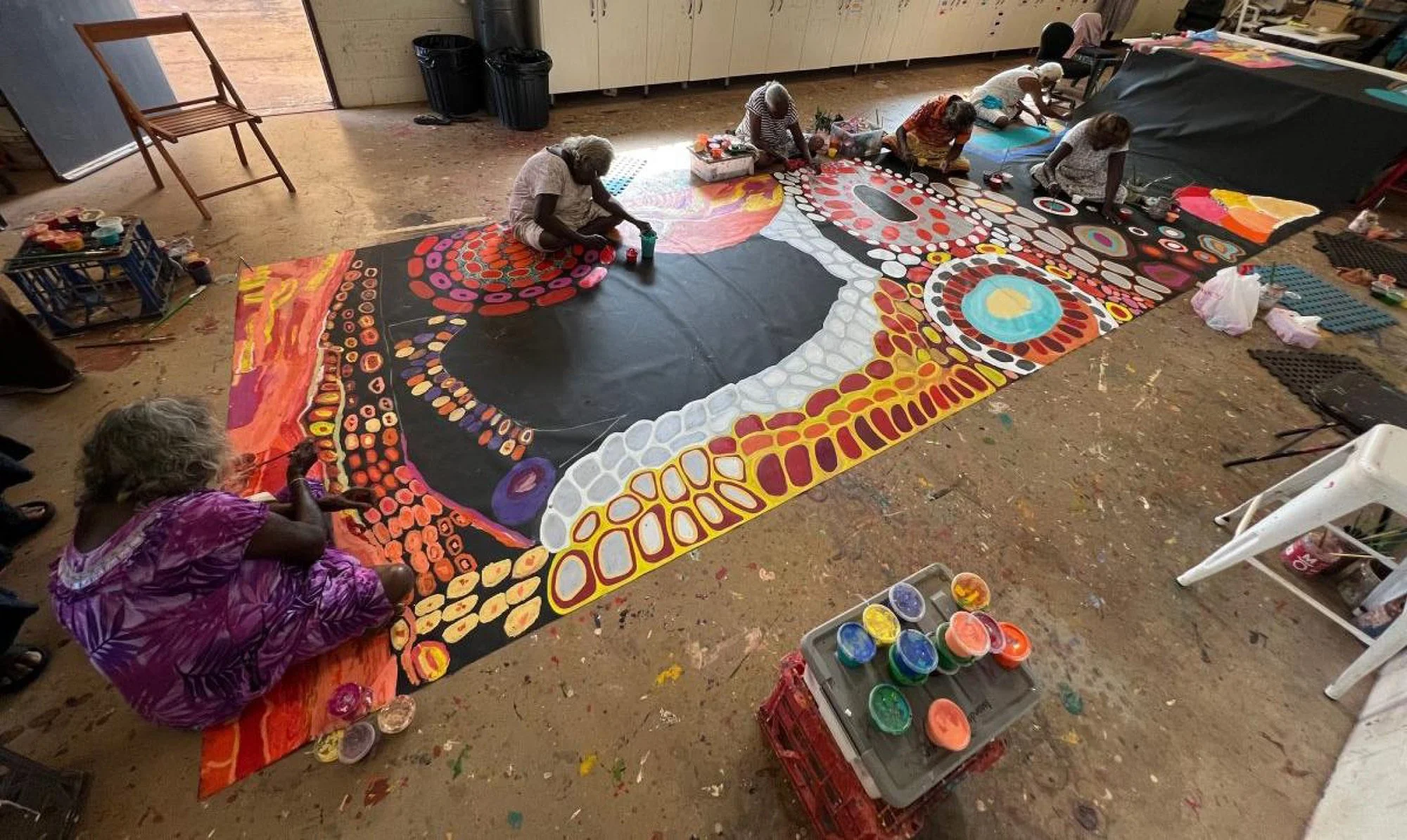
The case study report collates preliminary and baseline data investigating the work and workplace dynamics of a Far North Queensland IAC, Mirndiyan Gununa Aboriginal Corporation (aka MIArt), Mornington Island, as an embedded case study. The report presents the key outputs of the study and provides an overview of the IAC and its context to provide an historical and cultural overview. The outputs from this project are:
Literature Review
Indigenous Art Centres are not widely researched, particularly from a work or workplace perspective. An exploratory literature review focuses on research published since 2005 including academic research, grey literature, media reports and IAC websites. It examines how workplace and work in IACs relate to design and facility management challenges and opportunities. The literature review identifies 3 core principles for facility design and management: capability, belonging and multiplicity.Vignettes
The vignettes were prepared by John Armstrong and based on his embeddedness at the IAC and his relationships with staff, artists and community. The vignettes provide baseline and contextual information that reflects and can inform work and workplace considerations in facility design and management. Based on findings from the literature review, these vignettes are the most detailed and public account of how an IAC is used and the types of spaces and facilities provided in an IAC. These were developed with the intention of using them in ongoing research and applying them for further facility performance evaluation.Design Framework
The rationale for developing design and performance principles for Mirndiyan Gununa is to ensure that power remains with the community and users rather than designers and other contractors/service providers. It is intended to establish a baseline reflection of community power, voice, story, knowledge and truth so that this process is not duplicated or misdirected in future design, facility management and performance assessment processes. As noted in the report, a stream of consultants, government officials and researchers come into the community to consult with little, if any, discernible change resulting. Loops of consultation are rarely closed and consultation participants are rarely told how their contribution informed decision makers. The Design Framework is intended to ensure that community members do not have to repeat themselves.Facility Management Framework
The Facility Management Framework outlines a practical pathway and ongoing considerations for formalising facility management and shifting from a reactive approach to a more preventive and proactive approach. The Facility Management Framework is to be further developed in conjunction with Mirndiyan Gununa and supported by masterplanning. The research activity was focused on the development of vignettes to understand IAC spaces in relation to use. Through diaries and conversations, the utility and comfort of spaces was better understood, as was neglect and underresourcing. The Design Framework and Facility Management Framework can and should be better integrated and iterated in further work to be responsive to local conditions and priorities.
This research has found that facility management is a neglected aspect of IAC operations and that this is partly attributable to lack of attention and funding for facility management and partly attributable to lack of resourcing and skills for facility management. These issues are not unique to Mirndiyan Gununa and appear endemic across a range of infrastructures in the community. The findings also show how ingrained ‘settling for less’ and ‘making do’ has become in the community. IAC operations are not separate from their facilities or the infrastructure networks on which communities rely. Mirndiyan Gununa staff attention is diverted towards filling gaps of failing or inadequate local services including infrastructure system failures and outages. As workplaces, IACs are flexible and adaptive, responding to and cultivating intercultural and culturally responsive work practices. The experience of IAC staff, as reflected in diaries, conversations and vignettes, draws attention to the role buildings and spaces play in the daily operations and sustainability of the IAC as much more than a workplace or economic infrastructure.
Further Work
The report charts an ongoing relationship with Mirndiyan Gununa with the intention of building relationships with other IACs to strengthen facility design and management capability, recognising that work and workplace have significantly different meanings in and for Indigenous communities. The report also outlines a program of future work to communicate and expand this approach at multiple scales.
More Information
Please contact Dr Linda Carroli – l2.carroli@qut.edu.au
This project has been generously supported with a Design Strategy Grant from the Alastair Swayn Foundation and in-kind support from QUT Design Lab. It developed as a partnership with Mirndiyan Gununa Aboriginal Corporation.
