
Lived-In: A Post-Occupancy Evaluation of St Albans Housing
Researcher
NMBW Architecture Studio with Monash University and University of South Australia
Published
12 August 2024
Funding
Design Strategy Grant
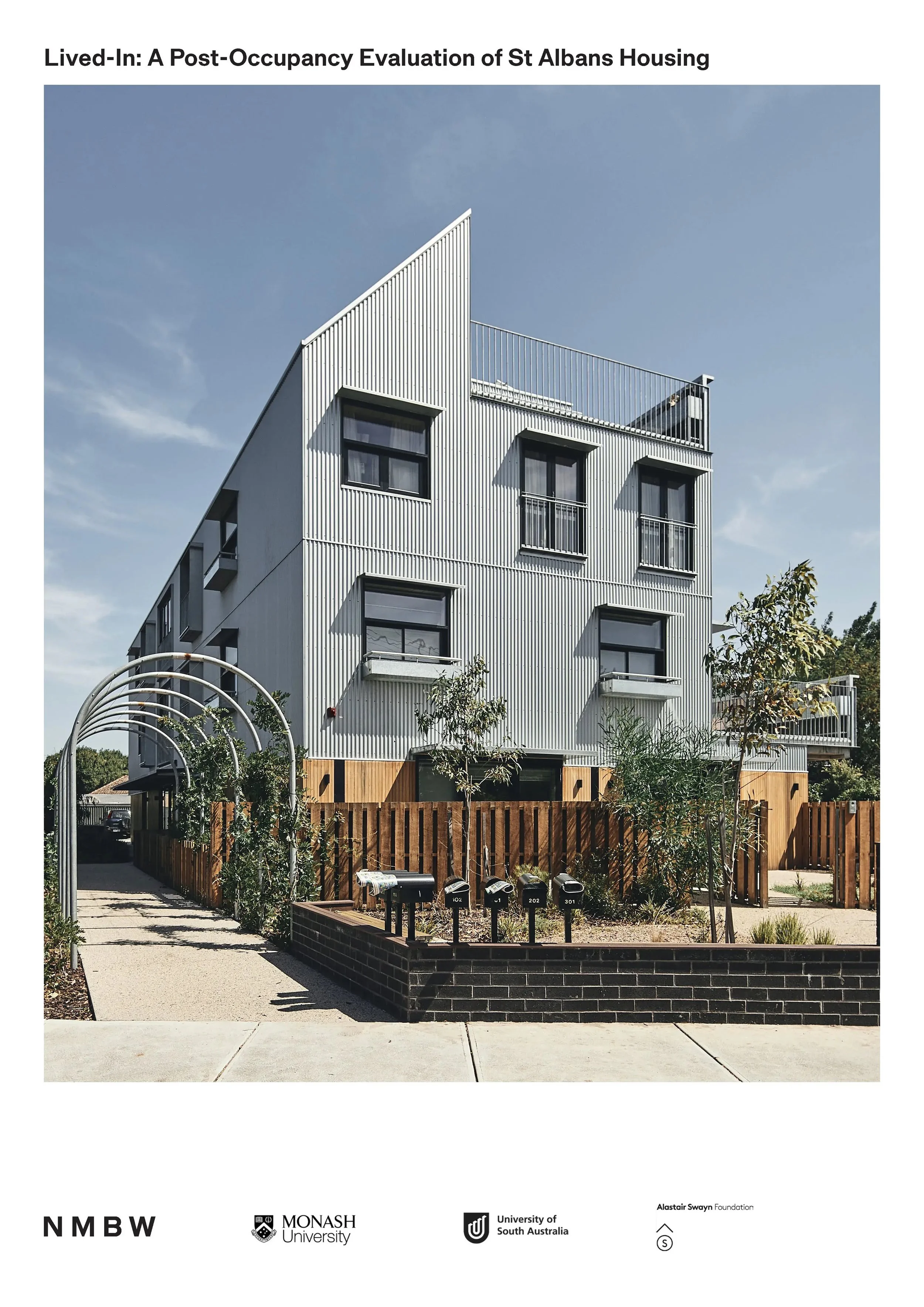
St Albans Housing, a mixed-tenure social and specialist disability accommodation, underwent a POE to assess its economic and social impact through interviews, lived-condition drawings, and cost-benefit analysis.
The Post-Occupancy Evaluation (POE) of St Albans Housing highlights the real-world benefits of thoughtful Australian architecture, examining flexibility, accessibility, connectivity, and affordability. It communicates design value beyond the architecture community to government and housing providers.
Delivered by NMBW, Monash University Urban Lab, and Housing Choices Australia, the research documents the social and economic impact of both the collaborative process and built outcomes, showcasing Australian leadership in design.
A rare Australian example of a POE incorporating social metrics, this study provides methodologies for assessing social value, supporting arguments for their inclusion in government and institutional fee structures.
Research Methods included:
Ethnographic Analysis – Resident and housing provider interviews, detailed architectural drawings, and photographic documentation.
Cost-Benefit Analysis – Evaluating financial and social returns using architectural and housing provider data.
Led by Nigel Bertram (NMBW), Mel Dodd, and Aaron Davis (UniSA), the research integrates qualitative and quantitative methods, contributing to global discussions on architecture’s social impact.
Note that the report has been designed to be viewed as a 2-page spread.
